
Animal Herbology
$87 · one-time payment
Ordering opens soon.
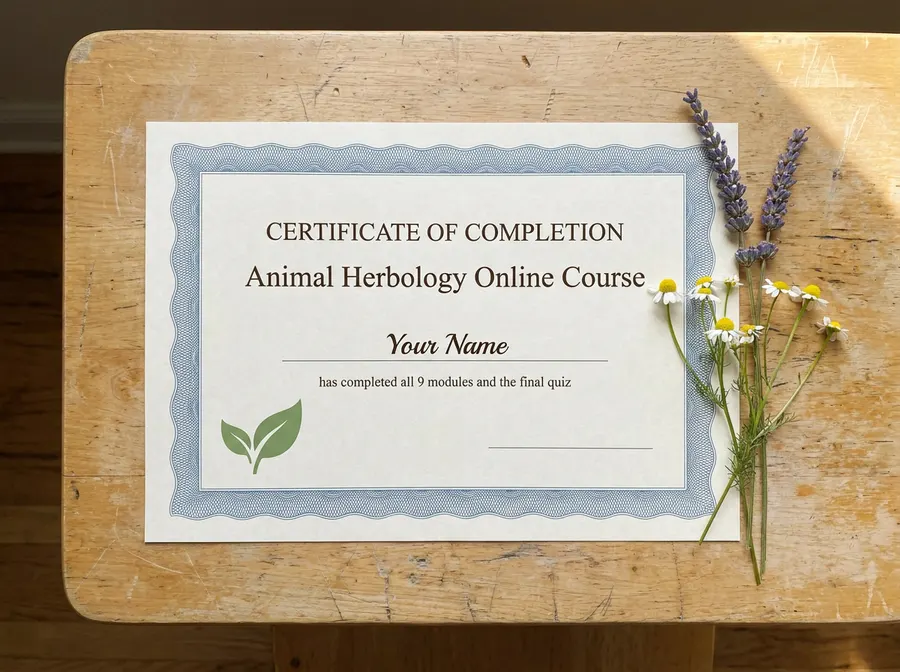
Certificate of completion
Finish the 9 modules and the final quiz to receive a certificate with your name on it.
Study your way
Flexible study at your own pace, on any device. The files are yours to keep.
30-day guarantee
Not for you? Ask for a full refund within 30 days.
Access Your Training Course Now
- ✓ Online training at your own pace and in your own time
- ✓ Text lessons, downloadable PDFs and audio versions
- ✓ Works on computers, tablets and mobile phones
- ✓ A quiz at the end of every module, then a final quiz for your certificate of completion
- ✓ Included: the essential 'Launch Your Business' Starter Pack
- ✓ Keep your course files for life
Training in Animal Herbalism
Your animal’s wellbeing through plants, season after season.
Why every animal lover should learn about herbalism…
Our animals depend on us. To feed them, to protect them, to open the door for them (yes!), and also to look after their wellbeing every single day.
Learning about plants is part of that responsibility.
It is much more than memorizing plant names. It is about building the knowledge to support their wellbeing and give them the best possible quality of life.
The lessons in this course will help you:
✅ Understand which plants herbal traditions associate with everyday comfort: digestion, skin and coat, calm, and more.
✅ Learn the seasonal routines herbalists use as the cold months approach.
✅ Know which plants are traditionally used for vitality and seasonal changes such as shedding.
✅ Recognize the plants that are toxic to animals, and which ones to keep out of reach.
✅ Have better-informed conversations with your veterinarian about natural options, always alongside their care, never instead of it.
Above all: prevent rather than react, support rather than force, and keep a watchful, loving eye on your companions.
Keep reading to the bottom of the page for the detailed program, with the plants and topics covered in each module.
Herbalism and its holistic approach
Plants have always been part of animals’ lives, even for carnivores. You may have seen a dog or a cat chewing grass. Animals seem to know which plants they are drawn to, and that instinct, learned from their mothers, is a precious inheritance.
Herbalism, the knowledge and use of plants, is not just an alternative practice. It is a path of its own, rich in tradition, in careful observation of living things, and in knowledge passed down through generations.
Applied to animals, it offers a natural and respectful approach to their wellbeing. Rather than looking at one sign alone, animal herbalism looks at the whole animal: its body, of course, but also its environment, its diet, its emotions and the needs of its species.
That whole-animal view is what makes it so relevant today, as more and more owners want a more conscious relationship with their furry, feathered or scaly companions.
Whether it is a tired body, the change of seasons, or a stressful period, plants can become real allies… as long as you know them well and use them correctly!
That is the whole purpose of this course: over nine modules, you learn the properties of each plant and the signs herbalists look for, always remembering that each organ and system is part of a larger whole, connected to the earth and the seasons.
Can you work as an animal herbalist?
Many people add herbal knowledge to work they already do with animals, as caregivers, pet sitters, groomers, dog trainers, behaviorists or breeders. Some go on to offer workshops or consultations of their own.
One thing matters above everything else: an animal herbalist is not a substitute for a veterinarian. They do not diagnose and never replace an ongoing treatment. They put the animal’s interests first, know their limits, and send people to a vet whenever it is needed. You will always work to support and comfort, within the law where you live.
If your love of animals and plants brought you here, know that you can start even without an existing client base. The qualities that matter most are listening, gentleness and empathy, observation and patience, a balance of rigor and flexibility, and respect for all living things.
As with any wellbeing practice, continued learning, hands-on experience and an open mind will be your best allies as you grow.
What you can charge depends on:
• How you work: one-to-one sessions, group workshops, visits where animals are kept, or online.
• The type of animal, since fees often vary from one species to another.
• Where you live and how far you travel.
Whatever you choose, it is a deeply rewarding path, full of meaningful encounters.
What makes this course unique?
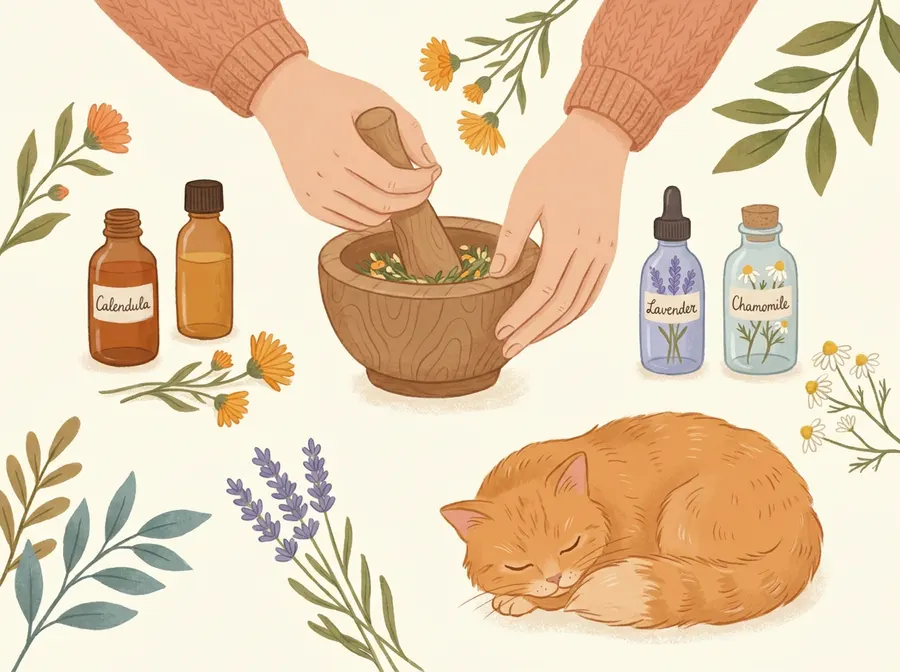
The program takes a fully holistic approach, combining animal herbalism with the teachings of traditional Chinese medicine (TCM). It is an exploration of a world where care, natural cycles and plants are woven together.
You will discover the five seasons of TCM, with their related organs, functions and elements… and, of course, the plants associated with each period. It is a way to reconnect with the rhythms of life and care for your animals all year round.
Across nine modules you will learn about the different preparation forms (decoctions, infusions, mother tinctures, standardized extracts and more) and when each one is used. You will also study homemade meal plans for cats and dogs, including the raw-food (BARF) approach for dogs, and the general principles herbalists use to adapt quantities to species, weight and situation, to review with your vet before you use any plant.
Each module includes practical activities to observe, feel and try, and case studies to reflect on. A quiz at the end of every module helps you lock in what you learned.
When you feel ready, take the final quiz. Score 80% or more and you receive your certificate of completion for the Animal Herbology course.
Here is the detailed program:
Module 1: Introduction to Animal Herbalism
This first module looks at the place animals hold in our society, with striking examples of animal intelligence and of how animals seek out plants by instinct. You will also look at how animal herbalism is perceived, including the criticism it sometimes faces and why some of it is fair, then study the different ways plants are prepared and given. The module covers:
- The importance of animals in our society.
- What animal intelligence is, with examples.
- How herbalism and veterinary care complement each other.
- The responsibilities of the animal herbalist.
- How animals instinctively seek out plants.
- A first look at why diet matters for good health.
- The preparation forms: fresh plant suspensions (SIPF) and standardized extracts (EPS), infusions, decoctions and macerations, compresses and poultices, mother tinctures, powders and capsules.
- The idea of the "whole plant" (totum).
- General principles of quantities by preparation form.
- General guidance on quantities for cats and dogs, to confirm with your vet.
Module 2: Prevention and good health for dogs and cats
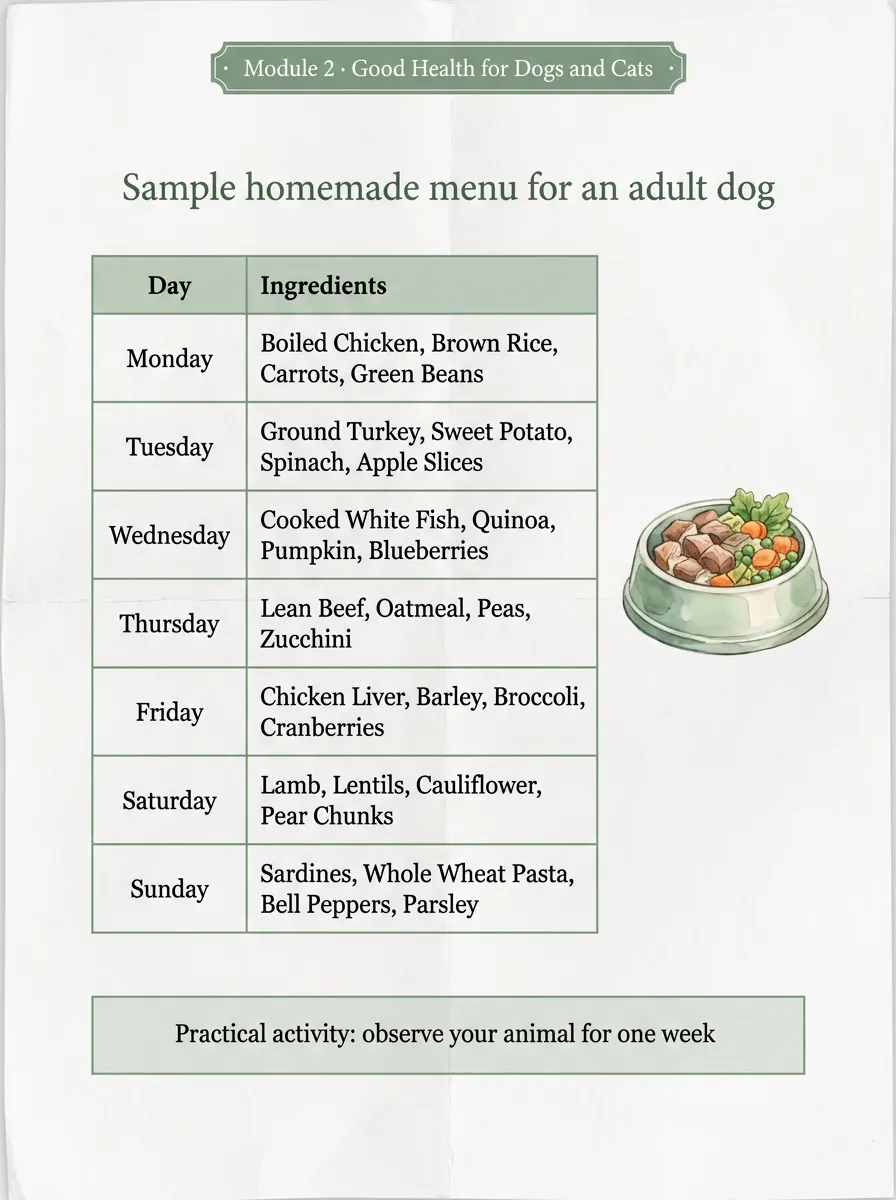
You start with what a healthy dog looks like: diet, nutritional needs, care and the ideal living environment. You are introduced to the BARF raw-food diet, the closest to the ancestral diet of dogs, with menus for adult dogs and puppies. Then cats: their behavior, their special relationship with smells, their diet and nutritional needs, with homemade menus for adult cats and kittens. The module ends with natural approaches to intestinal parasites. You will discover:
- Physical activity guidelines for dogs.
- How a carnivore’s diet has shaped the dog’s anatomy.
- Proteins, fats and carbohydrates in dog nutrition.
- What is inside commercial dog food.
- Homemade food.
- The ancestral (BARF) diet, with sample menus for adult dogs and puppies.
- Other care for dogs.
- An overview of cat behavior.
- Cats’ favorite smells, including plants such as catnip, olive and lavender.
- Cat nutrition in detail.
- Homemade meal examples for cats and kittens.
- Other care for cats.
- Signs that a cat is in good health.
- Why deworming matters, and the natural approaches herbalists use alongside your vet’s advice.
Module 3: Essential natural remedies
This module starts with the importance of a healthy home. Just like us, animals are exposed to pollutants in water, furniture, small objects, household and cosmetic products, cigarette smoke and pesticides. It then gives an overview of complementary approaches, so you know what exists and can explore further on your own, and presents the natural basics many herbalists like to keep at home. The module covers:
- Pollutants in the home: water, objects and furnishings, cleaning products, cosmetics, cigarette smoke and pest-control products.
- Homeopathy.
- Veterinary acupuncture.
- Gemmotherapy.
- Bach flower remedies.
- Oligotherapy.
- Apitherapy: honey, propolis, royal jelly, pollen.
- Hypnosis.
- Lithotherapy.
- Reiki.
- The natural basics kit: aloe vera, green clay, turmeric, coconut oil and more.
- A few hydrosols: thyme linalool, Roman chamomile, true lavender, orange blossom.
Module 4: Quantities and toxicity; plants for spring; the liver, gallbladder and thyroid
This module places the course inside a seasonal, holistic approach. First you learn how quantities change with the preparation form, how human products are adapted to an animal’s weight, and how to recognize poisoning and get emergency veterinary help fast. Then you explore plants through the lens of traditional Chinese medicine: its core principles, the links between organs and seasons, and the plants traditionally associated with each organ. Key points:
- How quantities are adapted, in principle.
- Converting human product quantities to an animal’s weight.
- Recognizing poisoning, and calling your vet or an animal poison line straight away.
- Traditional Chinese medicine basics: Qi, Yin and Yang, the Five Elements.
- The links between organs and seasons, with a summary for each season.
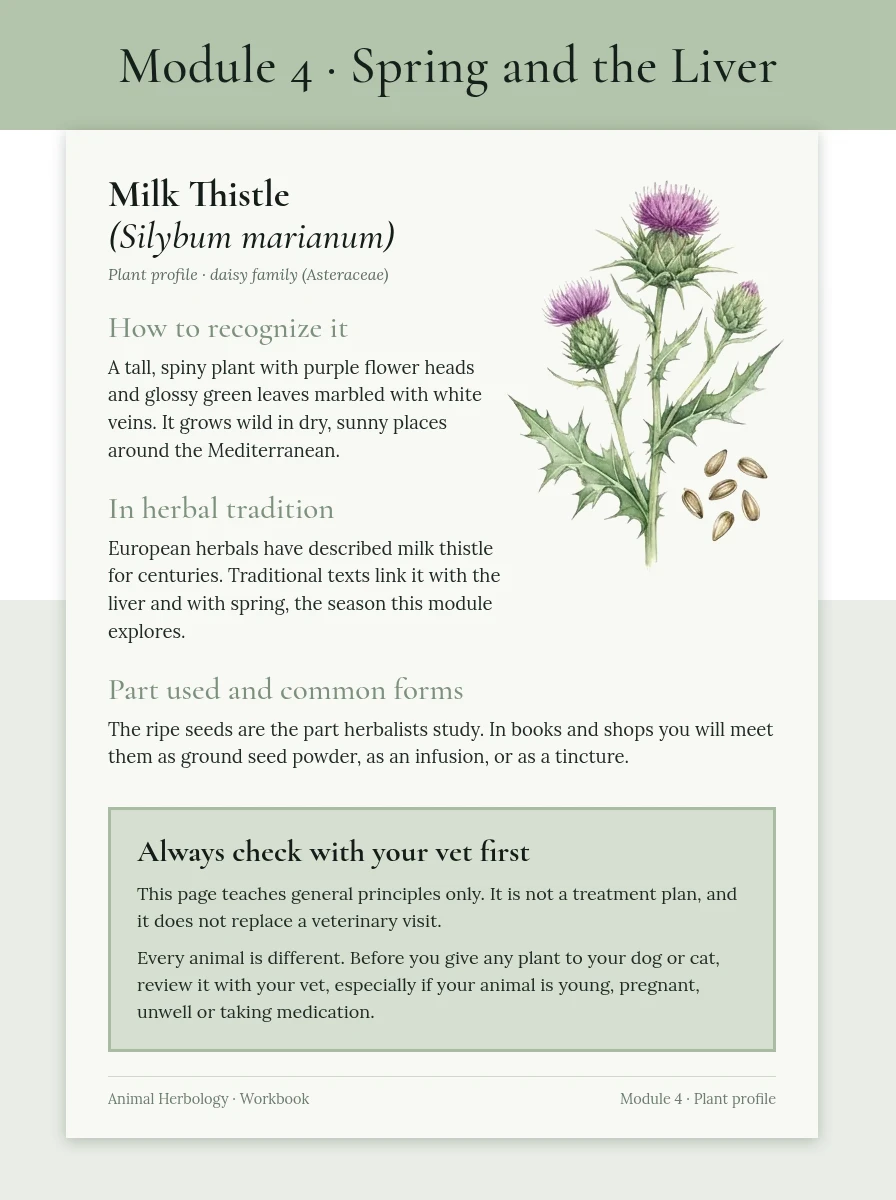
- The liver in TCM and the plants associated with it: milk thistle, desmodium, black radish, dandelion and others.
- The gallbladder and the plant associated with it: artichoke.
- The thyroid: its roles, the two main thyroid conditions vets see in animals, and the plants herbal literature mentions for each.
Module 5: Plants for summer; the heart, blood vessels and small intestine
Module 5 continues with the plants linked to summer in TCM. You study the heart, the blood vessels and the small intestine, their roles, and the conditions that can affect them. The module covers:
- The heart, its role and its link with summer.
- Plants associated with the heart: hawthorn and olive.
- The blood vessels and their role in TCM.
- Plants associated with circulation: ginkgo, red vine, feverfew, horse chestnut, sweet clover, witch hazel and others.
- The small intestine and its role in TCM.
- Plants associated with the small intestine: lady’s mantle, walnut leaf, Ceylon cinnamon, bay laurel.
Module 6: Plants for the late-summer season; the upper digestive tract, stomach, pancreas and joints
Traditional Chinese medicine describes a fifth season, between the end of summer and the start of autumn, linked with the Earth element. You learn the organs related to this period and the plants associated with them, including plants traditionally used around appetite. You also study modern conditions that affect our animals as they affect us, such as pancreatic conditions and joint stiffness, and how herbalism can sit alongside veterinary care. Course content:
- The upper digestive tract: mouth, esophagus, stomach and duodenum.
- Yellow gentian, traditionally used around appetite.
- Plants traditionally linked with appetite balance.
- Digestive plants: lemon balm and ribwort plantain.
- Plants associated with the stomach: cranberry, licorice and wild pansy.
- The pancreas and the plants associated with it.
- Diabetes in animals: what owners should know.
- Pancreatitis in animals: what owners should know.
- Joint stiffness and inflammation.
- Plants associated with joint comfort in herbal literature: devil’s claw, blackcurrant, meadowsweet, willow, turmeric, horsetail, nettle and others.
Module 7: Plants for autumn; the lungs, immunity, the large intestine and the skin
This module focuses on autumn, the season of the lungs in TCM. It opens with a breathing exercise for you, to release stress so you can be fully present with the animals in your care. You then explore the lungs, the immune system and the plants traditionally used to support them, followed by the large intestine and the skin. The module explores:
- The lungs, their role and their link with autumn.
- Plants associated with the respiratory system: Scots pine, niaouli, eucalyptus radiata and others.
- How plants are combined in herbal tradition.
- How the immune system works.
- Plants traditionally used for the body’s defenses: echinacea, cypress.
- Two mushrooms used in herbal tradition: reishi and shiitake.
- The large intestine, its link with the lungs in TCM, and associated plants.
- The roles of the skin.
- Plants associated with the skin: burdock, aloe vera, calendula.
- Other natural preparations for skin and coat, such as balms and oils.
Module 8: Plants for winter; the kidneys, bladder, prostate, endocrine system and bones
This module covers winter, the last season in TCM, linked with the kidneys and the urinary system. You learn the roles of the kidneys, bladder and prostate, then two systems that are often overlooked in animals: the endocrine system and the bones, so important for mobility. It ends with plants traditionally associated with mood and behavior. You will learn about:
- The kidneys and their role.
- Plants associated with the kidneys: orthosiphon, mouse-ear hawkweed, bearberry.
- The bladder and its importance in TCM.
- Plants associated with the bladder: tribulus, birch, cranberry, heather and ash.
- Prostate problems in dogs: what owners should know.
- Plants associated with the prostate, including hops.
- The glands of the endocrine system and their roles.
- Plants associated with the pituitary gland.
- Plants associated with the female reproductive system: clary sage and raspberry leaf.
- Plants associated with lactation, including mucuna.
- Plants associated with the male reproductive system, including ginseng and ginger.
- Bones and bone conditions.
- Plants associated with bones, including horsetail.
- Plants traditionally associated with calm and mood.
Module 9: Common concerns A–Z; birds, rodents, horses and other animals
The final module brings it all together. It walks through the most common concerns owners face, with the signs to watch for, when to see your vet, and what herbal traditions describe for each. It also explains how care differs between dogs, cats, horses, birds, reptiles and rodents, and ends with a bibliography so you can keep learning. Module content:
- Final advice on the most common concerns.
- Skin and dental abscesses.
- Allergies: food, skin, seasonal, flea.
- Weight loss and loss of appetite.
- Joint pain, and the difference between osteoarthritis and arthritis.
- Asthma in cats.
- Burns, wounds and bruises.
- Eye irritation and conjunctivitis.
- Constipation and diarrhea.
- Cat flu (coryza).
- Stress and anxiety.
- Lick dermatitis.
- Gum problems and bad breath.
- Weight gain.
- Fleas, ticks and insect bites.
- Vaccinations.
- Old age.
- Extra guidance by species.
- Rodents: diet, behavior and care.
- Birds: diet, behavior and care.
- Bibliography.
Your name on a certificate
Complete the course and the final quiz, and receive a personalized certificate of completion with your name on it, so you can show your new knowledge of animal herbology with pride.
It is a certificate of completion for this course. It is not a veterinary qualification or an accredited professional license.
A look inside the course
Tap a page to zoom
+ Included

The Essential 'Launch Your Business' Starter Pack
A practical starter guide for turning your knowledge into workshops or sessions: first steps, how to present your services, and the questions to answer before you start.
Frequently asked questions
Everything you need to know before you start.
How do I enroll?
Tap the button, enter your email and complete the secure payment. Your course files are sent to your email after payment.
How long do I have access?
For life. The text lessons, PDFs and audio files are yours to keep, so you can study at your own pace on any device.
Is the course 100% online?
Yes. Everything is digital: read or listen on a computer, tablet or phone. Nothing is shipped.
Can I get a refund?
Yes. If you are not satisfied, email us within 30 days of your purchase for a full refund.
What materials are included?
Text lessons, downloadable PDF study guides, audio versions of the lessons, module quizzes, the final quiz and the Launch Your Business Starter Pack.
I can't find my files.
Check your spam folder first. If you paid with Apple Pay or Google Pay, the files go to the email you typed at checkout. Still nothing? Contact us and we'll resend them.
Do I need any prior qualifications?
No. The course is for anyone who loves animals and plants, whether you are a pet owner or want to work with animals.
Is this veterinary training?
No. This is an educational course. It is not veterinary training, it does not give veterinary advice, and it never replaces your veterinarian. Always talk to your vet before giving any plant, supplement or preparation to an animal.
Will I get a certificate?
Yes, a certificate of completion with your name once you finish the course and score 80% or more on the final quiz. It is not an accredited qualification.
How do I pay?
Apple Pay, Google Pay, Visa or Mastercard through Stripe. One-time payment, no subscription; it shows on your statement as KHAYARY.
Start your course today, risk-free
Unlock the world of animal herbology with our 30-day money-back guarantee. If the course is not right for you within the first month, we will gladly refund you in full. No stress, no risk.
🔒 Secure checkout
Digital course (text, PDF and audio). Educational only, not veterinary advice. One-time payment, sent to your email after payment. Shows on your card statement as CARTJAR.
Privacy · Terms · Contact us
- Format
- Online course · PDF · Audio
- File language
- English
- Delivery
- Instant download
- Refund
- 14 days
Buyer reviews
No reviews yet. Only buyers can review, and every review is published, good or bad.
Sold by
CartJar
You may also like

Crafts & Patterns
180+ Leather Patterns
180+ printable leather patterns with every piece labeled and measured, plus a commercial license. Digital files sent to your email after payment.

Crafts & Patterns
Master Pack: 130+ Wood Projects
130+ ready-to-build woodworking projects with precise cut lists, in inches and centimeters. Digital plans sent to your email after payment.

Pets
The Complete Dachshund Guide
The Complete Dachshund Guide: a step-by-step plan for sleep, potty training, barking, separation anxiety and back-safe habits, plus 5 free bonuses. Sent to your email after payment.